Dogs Do Not Tie Themselves to Trees
Wishbone’s story begins with something that should be impossible to rationalize.
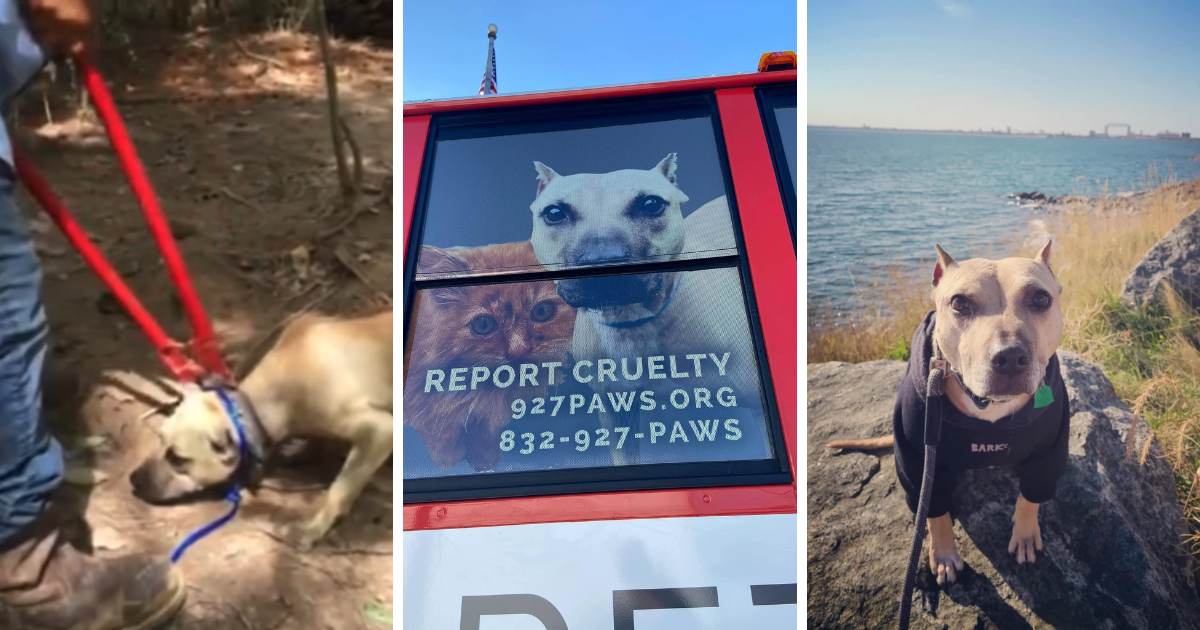
He was found chained to a tree in Grimes County, Texas.
Fourteen other dogs were discovered nearby. Many tethered with heavy metal chains. No meaningful shelter. No reliable protection from heat or storms. Food and water dangerously inadequate. Bodies marked by lacerations, wounds — visible evidence of prolonged neglect and violence.
Authorities stated the conditions raised serious concerns of organized dog fighting.
Fifteen living beings surviving at the end of restraints.
This was not an accident. This was not bad luck. This was not a misunderstanding.
Dogs do not tie themselves to trees.
Conditions like this do not exist without human decisions placing animals there — repeated moments where responsibility was abandoned and suffering was allowed to continue.
Authorities investigated. Charges were filed. The owner was arrested and later pled guilty to multiple counts of Cruelty to Non-Livestock Animals.
Guilty.
Not alleged. Not speculative. Not misunderstood. Legally acknowledged cruelty.
Fifteen counts.
Under Texas law, each count carried the possibility of jail time and thousands of dollars in fines — penalties meant to reflect the seriousness of animal abuse.
And the punishment imposed? Twenty-four months probation. A $500 fine. No visible jail sentence. No consequence remotely proportional to the suffering uncovered.
Fifteen dogs living in brutal conditions. Five hundred dollars.
Less than what rescues spend trying to repair the damage inflicted. Less than the medical cost associated with even minor neglect cases. A penalty so small it barely registers beside the physical and psychological harm endured by living beings who had no control over their circumstances.
This is the fracture point rescuers live with.
Cruelty devastates animals.
The consequences for humans are often negligible.
The system did not meaningfully punish the suffering. It processed it.
While the legal case concluded, Wishbone’s survival journey was only beginning.
He entered the Houston Humane Society. Stabilized. Given safety. But rescue does not erase trauma. Nervous systems shaped by neglect do not reset because charges are filed.
Northern Lakes Rescue later stepped forward and tagged him. A commitment. A refusal to let his story end as just another cruelty case with minimal consequences.
Wishbone entered professional training. Not to make him easier. Not to make him marketable.
But as a necessary safety measure for a dog whose entire life had been shaped by fear, instability, and survival.
Then Wishbone traveled north. And once again, a human decision reshaped his fate.
A foster said yes.
Yes to uncertainty. Yes to complexity. Yes to a dog carrying trauma with no guarantees attached.
Complex dogs do not come with predictable roadmaps. They come with unknowns most people avoid — patience, behavioral work, emotional rebuilding measured in months and years rather than days.
His foster — who would later become his adopter — accepted all of it.
Wishbone healed. Slowly. Patiently. Learning safety. Learning stability. Learning how to exist without survival mode dictating every response.
Years later, another challenge emerged. Wishbone was diagnosed with Lungworm.
A severe medical battle requiring extraordinary intervention.
Major surgery. Intensive hospitalization. Partial lung removal.
And again — his human said yes.
Yes to fear. Yes to uncertainty. Yes to fighting for him.
Wishbone survived cruelty. He survived surgery.
He survived realities imposed by a system that delivered minimal punishment for the human decisions that nearly ended his life before rescue ever intervened.
Which makes the final irony impossible to ignore.
Wishbone — a dog once chained to a tree in a cruelty case that resulted in probation and a minimal fine — is now the face of a campaign that reads:
“REPORT CRUELTY.”
A message implying protection. Enforcement. Accountability.
Yet in his own case, reporting cruelty produced consequences so light they barely register beside the suffering documented.
There is something deeply infuriating about that contradiction.
A dog whose abuse carried almost no meaningful punishment now serves as the public face of a system that too often fails to deliver the accountability it promises.
Rescuers understand this reality intimately.
Because cruelty cases are not resolved by slogans. They are resolved by animals surviving despite them.
Wishbone is not remarkable because cruelty happened.
He is remarkable because he survived it. Because he healed. Because he continues to love in a world that gave him every reason not to.
Wishbone loved us anyway.
Those in rescue will never stop being angry about why they ever had to survive and love us anyway.